Thursday, May 23, 2013

Guangxi: Longji Rice Terraces

In April, two of my college besties, The Blondes, came to visit. Within 24 hours of landing in Shanghai, we had boarded a plane and jetted off to Guilin, in the southern province of Guangxi. 

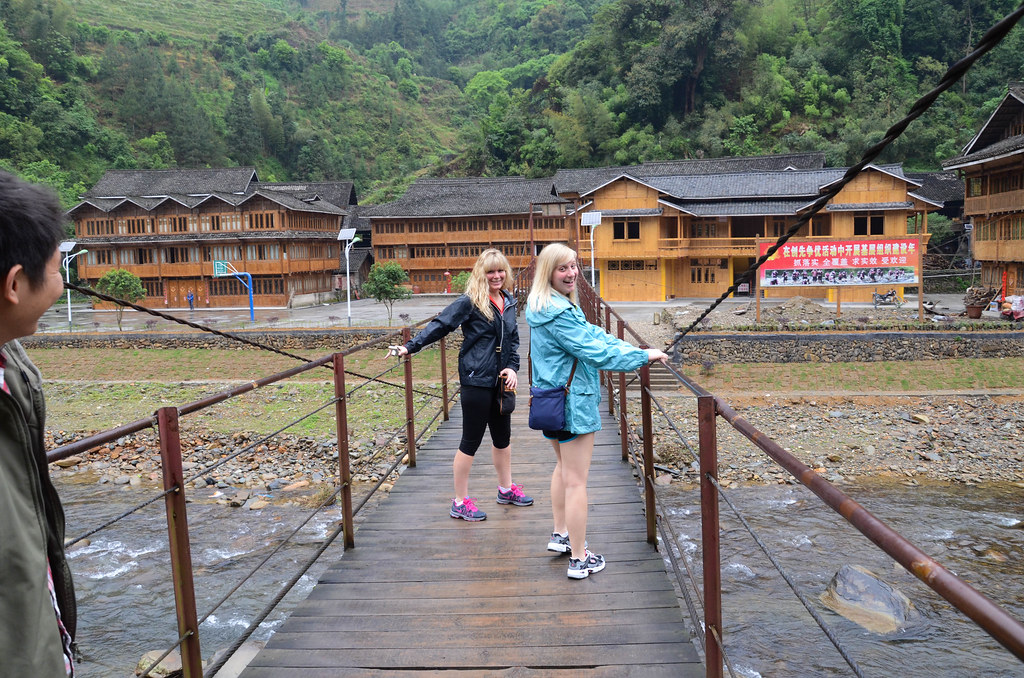
Two hours northwest of Guilin is nestled the beautiful town of Longji. We wandered through the quaint town which was only accessible by a lovely swaying bridge. Not a fan.

DSC_8150.jpg

DSC_2851.jpg

Along the way, we were greeted by women from the Yao minority population, famous for their long hair. The Yao women cut their hair only once during their lives at age 16 when beginning the search for their husband. Considered masters of handicrafts, they are also known for the wares they peddle throughout the village.

DSC_2872.jpg

DSC_2891.jpg

DSC_2894.jpg

The only way to reach the top of the rice terraces is on foot. While the hiking isn't too strenuous, it does require that you carry your suitcase to the top if you are staying at one of the local hotels (we were not).  Or you could pay one of the local women to do it for you.

DSC_2890.jpg

Once at the summit, we were surrounded by beauitful views of the rice terraces below, established over 700 years ago. The terraced fields were built along the slope winding from the riverside up to the mountain top, the highest part reaching 2,800 feet (or 880 meters).

DSC_8170.jpg

DSC_8172.jpg

DSC_8182.jpg

DSC_2961.jpg

DSC_2938.jpg

DSC_2922.jpg

DSC_2959.jpg

DSC_2967.jpg

After a few hours of hiking in the rice paddies, we sat down for a lunch of traditional local food. This included rice stuffed inside bamboo shoots and cooked over an open flame.

DSC_8158.jpg

DSC_2989.jpg

We also feasted on Guilin noodles, eggplant, and a little Chinese beer.

DSC_2984.jpg   

DSC_2987.jpg

DSC_2990.jpg 

DSC_2986.jpg

Our meal did not include roasted mountain rat which was apparently a local delicacy. My guests were more than happy to miss out on that experience.

DSC_8154.jpg

Tuesday, May 21, 2013

Zhujiajiao

When my friend K was visiting in March, we decided to leave the hustle of modern Shanghai for an afternoon and headed to the once sleepy water town of Zhujiajiao. Unfortunately, we weren't the only ones with this idea and were greeted with throngs of people upon our arrival. Sigh.

DSC_2770.jpg

Located in a suburb of Shanghai, the town of Zhujiajiao is an ancient water town that is roughly 1,700 years old and served as an important trading post for the surrounding countryside. Traditionally, goods and people were ferried on the small canals from house to house, passing under the stone bridges that are still in use today.

DSC_2773.jpg

We opted to buy the 100 rmb entrance tickets which provided us with a boat cruise and entry into nine scenic spots such as the Y-Art Gallery, a traditional medicine shop, the City God Temple, and Kezhi Garden. While I enjoyed Kezhi Garden and the City God Temple, the majority of the other attractions weren't overly interesting.

DSC_2745.jpg 

DSC_2813.jpg

DSC_2818.jpg

DSC_2783.jpg

DSC_2766.jpg

After watching our boat man row for awhile, I figured I would give it a try. Harder than it looks, trust me.

DSC_2780.jpg

DSC_2823.jpg

We wandering around for the better part of an hour until the intense shoving of the crowd wore down both my nerves and civility. Thankfully, Matthew and K were happy to break off from the main streets as we made our way back to the entrance. We meandered down small alleys, past walls filled with children's drawings and adorable puppies.

DSC_2806.jpg 

DSC_2830.jpg 

DSC_2848.jpg

Zhujiajiao is certainly touristy but in a starkly different way than the city of Shanghai. Here, life seems a little more simple and a little more, well, ancient. You cannot yet see skyscrapers peaking above the roofs of temples. Though with the rapid pace at which China is growing, I imagine it's only a matter of time.

Wednesday, May 15, 2013

DIY Chair

Do it yourself tutorials are all the rage these days. I constantly see headlines and blog titles that apparently will tell me how to make a pillow out of my favorite T-shirt or the best way to clean my baking pans.

So today, I present you with a simple tutorial from the streets of China.

How to make a chair

Step 1: Grab two water bottles of identical height
Step 2: Sit on them
Step 3: Relax?


image002

Ok, that last step might not be too clear. Too much relaxing will probably break your brand new chair. And then what would you have to blog about?

Monday, May 13, 2013

Napping 4.0

Napping was one of my favorite things to do in college. I would sit in class, counting down the minutes until I could go home and snuggle under my plush comforter. In Shanghai, I inevitably end up falling asleep, cat on my lap, whenever I attempt to do my Chinese homework. No matter the circumstance, napping for me conjures up images that involve the words warm, soft, and comfortable.

But in China, hard, metal, and thong will apparently do the trick.

image001
Photo courtesy of my friend Tom, who clearly has a knack for finding odd nappers.

Wednesday, May 8, 2013

Panda Loving

While visiting the Panda Research Base, Matthew and I held a baby panda. I cannot even begin to describe how excited I was for this. My face actually hurt from smiling. I was more enthusiastic than a tween at her first Justin Bieber concert.

DSC_2432

But holding a panda isn't cheap. However, I considered this opportunity to be a once in a lifetime event and happily ponied up the 2000 rmb/person ($325) "donation". (Note: Friends of ours only had to donate 1300 rmb in November 2012 for this experience. The price appears to increase rapidly every few months).

The base does a decent job of stretching the panda holding into an experience of sorts. We were first given a lesson on the breeding practices that take place on the base. There isn't much natural procreation going on there, in case you were wondering. We next learned about feeding the pandas and finally, we got our up close and personal experience with the panda.

After washing our hands, we were outfitted with booties and sterile gowns to wear. Totally attractive, right?

DSC_2423

Then it was time to snuggle with the panda. The zookeeper handed me a piece of bamboo coated in honey to feed the panda in hopes of keeping him occupied during our little photo session. He must have though I was pretty sweet, because when his honey ran out, he gave my cheek a nice slobbery lick.

DSC_2441.jpg

Matthew missed out on a panda makeout session during his turn though as the little guy was rather preoccupied with an apple slice.

DSC_2529

DSC_2539

While we may have left the Panda Research Base with a little (okay, a lot) less cash in our pockets, I would absolutely pay to hold a panda again. Besides, at least our donation went towards the conservation of pandas. Because the world is just a little bit cuter (and slobbery) with these gentle beasts around.

Monday, May 6, 2013

Chengdu Panda Research Base

Our final morning in Chengdu was spent at the Chengdu Research Base of Giant Panda Breeding. The Panda Research Base is a non-profit organization engaged in the research, breeding, and conservation of giant pandas. The facility is now home to around 200 pandas including both the namesake giant panda as well as the lesser known red panda.

DSC_8134

The cool temperatures combined with a morning snack led to fairly active pandas who we observed munching on bamboo, taking a bath, hanging out in trees, and playing with each other.

DSC_8013

DSC_8005

DSC_8110

DSC_2319

DSC_8100

DSC_2649

DSC_2207

We also got a chance to see the red pandas, which look quite similar to raccoons.

DSC_8121

DSC_8125

I was particularly entertained by two baby pandas who managed to fall off their jungle gym. Cute as they were, it wasn't hard to see why these adorably clumsy mammals have landed on the endangered species list.

DSC_8075

DSC_8079

DSC_8086

DSC_8088


Travel Information

Located just six miles from downtown Chengdu, your best bet is to grab a taxi to the base for around 30 RMB. Otherwise, hop on bus 60 and get off at the Longqing Road/Shulong Road Station.

The base is open year round from 8:00 am - 6:00 pm though I would recommend visiting during the morning feeding (around 9:00 am) for your best chance to see the pandas in action. They sleep the rest of the day.

Admission to the base is 58 RMB/person.

Wednesday, May 1, 2013

Greatest Day of My Life

I'll post a full recap of my visit to the Chengdu Panda Base in the near future. But for now, all you need to know is that this happened.

Panda Lick (I can't seem to embed the gif so just follow the link for now)

At one point during the day, I looked at Matt and exclaimed, "This is the best day of my life". "Even better than our wedding day?" he asked sweetly. "Totally".


Related Posts Plugin for WordPress, Blogger...